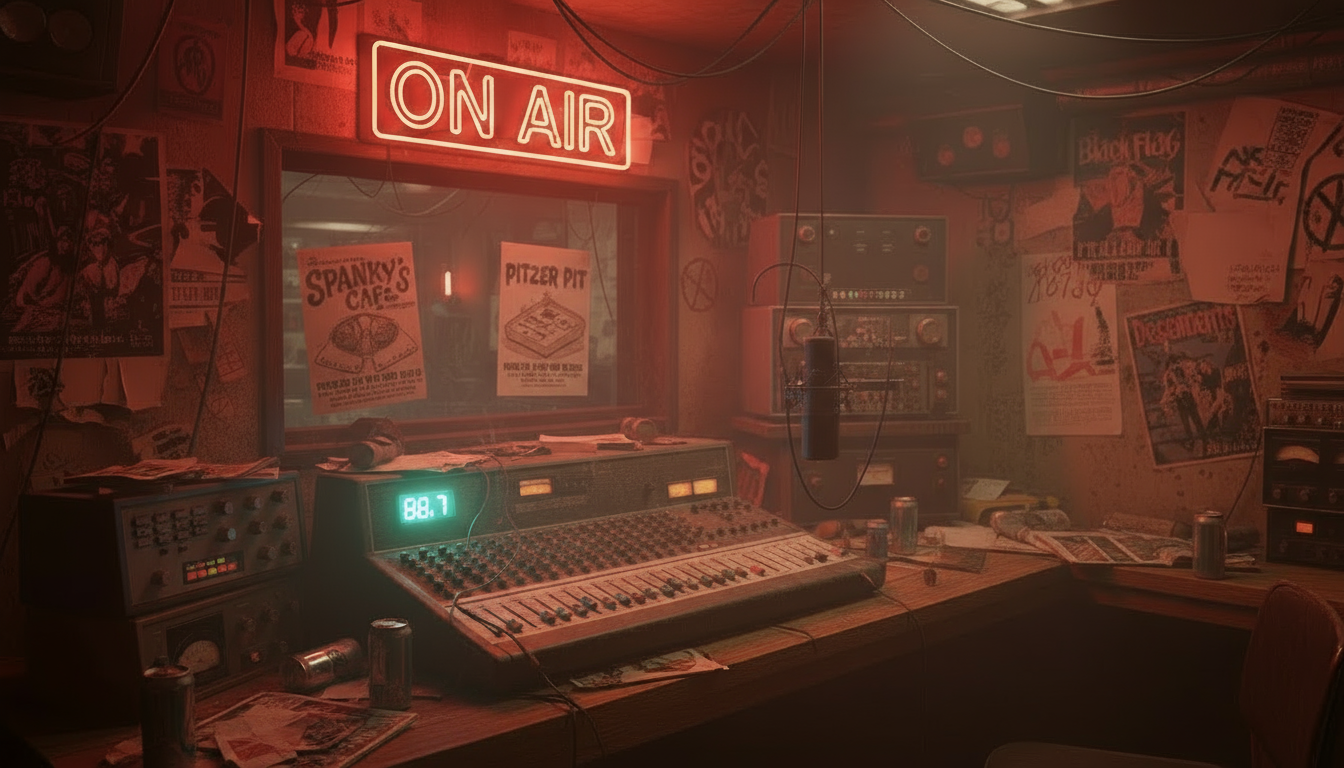
How the harsh landscape and DIY ethos of Southern California’s Inland Empire created the perfect breeding ground for Spanky’s Cafe and the Pitzer Pit.
The IE has never been anyone’s idea of a creative mecca. Sprawling eastward from Los Angeles like an endless concrete afterthought, this sun-baked expanse of strip malls, tract housing, orange groves and abandoned lots seemed designed to crush artistic dreams rather than nurture them. But that’s exactly why it worked.By the early 1980s, a lot of skateparks had closed due to lawsuits and Skateboarder Magazine cemented the nickname The Badlands in a 1979 feature. It wasn’t meant as a compliment. The region’s harsh desert climate, smog, economic stagnation, and cultural isolation created a landscape half post-apocalyptic, half suburban dead-end. Yet within this void, something vital was brewing—a scrappy creativity born from necessity that would eventually give birth to two of Southern California’s most important alternative music venues: Spanky’s Cafe in Riverside and the Pitzer Pit in Claremont.The Badlands Philosophy: Making Something from NothingThe skaters who coined the Badlands moniker weren’t being dramatic—they were being literal. Legendary spots like Baldy Pipe — a massive drainage tunnel built for the San Antonio Dam — embodied the region’s raw appeal. Every tale of a “Baldy” session started with a grueling hike down the mountain and a slip through the gap in a chain-link fence. Then came the rickety plank — a 2x8 stretched over an eight-foot drop that you had to inch across with your board under your arm. You always hoped it hadn’t fallen or cracked since the last time, because if it had, you’d be falling in and then scaling the slanted wall to get back out. Even if you made it in, there was always the chance of cops waiting with trespassing tickets on the way out or the thought of a flash flood ripping through the tunnel. Inside, the air turned damp and cold, wheels echoing against the concrete while musty spray paint smelled like it was dripping from the ceiling.Other iconic Inland spots carried the same energy — the Upland Pipeline skatepark, a testing ground for future legends, and the Nude Bowl, a drained desert pool previously a nudist colony that became a pilgrimage site for the fearless.The IE’s skate scene was defined by resourcefulness: abandoned pools behind foreclosed houses, drainage ditches that doubled as halfpipes, and loading docks that served as launch pads. Skaters learned to see potential in the discarded and overlooked—a mindset that would spark the punk scene that emerged alongside it.The crossover between skating and punk wasn’t accidental. Both cultures celebrated the outcast, the something from nothing aesthetic, and the transformation of hostile environments into creative spaces. During this era, where mainstream entertainment options were limited and expensive, kids learned early that if you wanted something to happen, you made it happen yourself.Spanky’s Cafe: Where Punk Learned to SweatBy the time Spanky’s Cafe opened its doors in Riverside in the mid-1980s, the groundwork had been laid. The venue, originally a coffee shop and restaurant, began hosting punk shows almost by accident when local promoters needed a place to book touring bands that mainstream venues wouldn’t touch.Spanky’s quickly became legendary for its intimacy and intensity. The small room forced audiences and performers into close quarters, creating an electric atmosphere where the line between performer and audience dissolved. Bands played inches from sweating, slam-dancing crowds, and the lack of a proper stage meant that anyone could become part of the show.This wasn’t the sanitized punk rock that MTV would later package for mass consumption. Spanky’s hosted hardcore bands like Agnostic Front, The Accüsed, D.R.I., Insted, Chain of Strength, Inside Out, Judge — groups too raw, too political, or too experimental for larger venues. Just as often, the calendar bent toward ska — Hepcat, Voodoo Glow Skulls, even a young No Doubt — packing the café with a different kind of chaos. The booking policy was simple: if you could draw a crowd and wouldn’t destroy the building, you could play. This openness attracted both established touring acts looking for an authentic venue and smaller bands building followings outside LA.Getting to Spanky’s was half the adventure. The night The Accüsed played, our hatchback kept breaking down on the freeway. Hood popped, a friend rode up front smacking the carb with a wrench while we crawled along the shoulder until we finally cruised into Riverside, crammed shoulder to shoulder. Later that night he climbed a stack of speakers and stage-dove into the crowd. When the amps finally cut, we didn’t head home — we headed straight for the plaza fountain across the way and dove in fully clothed, like that was the real encore.The venue’s success reflected the broader IE punk mindset: create your own space, support your community, and never compromise for commercial appeal. Spanky’s proved that punk could thrive outside the traditional music industry infrastructure, inspiring a generation of DIY promoters and venue operators.The Pitzer Pit: Academia Meets VolumeWhile Spanky’s was holding down the working-class Riverside scene, Claremont’s Pitzer College was nurturing its own punk experiment. The Pitzer Pit, a basement venue in the college’s residence halls, represented a different but equally important model: the collision of academic freedom with the raw force of 100db of distortion.Pitzer College, one of the liberal arts Claremont Colleges, had always encouraged student activism and artistic expression. When students began organizing shows in dormitory basements in the late 1980s, the administration’s response was surprisingly supportive. The Pit became a place where experimental music and street level booking thrived just beneath the college’s polished surface.The venue attracted a diverse crowd that mixed Claremont’s student population with punks from across the IE and beyond. Bay Area legends Jawbreaker tore through a set here. One night still burns brighter than the rest: Rage Against the Machine rattled the basement, Zack de la Rocha shouting from a foot-high stage like the room couldn’t hold him. We’d rolled through because his first band had legend status, Inside Out, but nothing prepared us for what they sounded like that night. After the set they sold cream-colored cassette tapes off a table, and my friend grabbed one. That tape lived in his parents’ sedan for months — blasted on the way to school, warped in the heat — a bootleg memory that outlasted the ringing in our ears. Ani DiFranco sang until those walls felt like they might split. J Church left behind a Halloween recording that became its own artifact. That basement proved a campus could hold as much weight as any club on the Sunset Strip.The Pit’s influence extended beyond its walls. With KSPC broadcasting and documenting much of the activity, the shows reached ears across the valley. Word spread by flyers, fanzines, and whispered stories — and without digital proof, the nights took on the glow of legend. If you weren’t there, you only had someone else’s story, which always made it sound bigger.KSPC: The Voice in the WildernessWhile the Pit was rattling basements, another crucial piece of the Claremont ecosystem kept the scene pulsing. KSPC 88.7 FM, Pomona College’s radio station, had been broadcasting since 1956, but by the 1980s it was a lifeline for alternative culture. Unlike commercial stations that ignored anything outside the mainstream, KSPC embraced the weird, the experimental, and the aggressively uncommercial. DJs spun hardcore punk alongside jazz fusion, industrial noise next to reggae, creating an eclectic sonic landscape that reflected the hunger of a region starved for alternatives.More importantly, KSPC served as an information network. Between songs, DJs announced upcoming shows at venues most people had never heard of, creating a loose network of musicians, artists, and misfits across the sprawl. Operation Ivy even blasted out a live set over KSPC’s airwaves, proof that influential acts were finding their way to Claremont before major labels cared to notice. And if you were anywhere near Claremont, you ended up at Rhino Records sooner or later — I went at least once a week to dig through the crates, chasing deals on hidden gems and seven-inches that never stayed on the shelf for long.Legacy of the BadlandsThe success of Spanky’s Cafe and the Pitzer Pit reflected a broader transformation in American alternative music culture during the 1990s. As the major label feeding frenzy around grunge and punk reached its peak with bands like Green Day and Nirvana, venues like these built thriving networks based on connection rather than commerce.The IE’s harsh landscape and economic isolation, once seen as obstacles to cultural development, proved to be assets. Without access to mainstream entertainment or industry infrastructure, fans created their own networks, developed their own aesthetic, and built venues that prioritized intensity over profit margins.This grounded approach resonated far beyond the IE’s borders. The success of underground venues like Spanky’s and the Pitzer Pit inspired similar efforts across the country, contributing to the explosion of independent music that would eventually reshape the entire industry. The Badlands had taught an important lesson: the fringes weren’t where culture went to die—they were where it went to reinvent itself.The mythology is still alive. In 2025, the Riverside Art Museum opened 60 Miles East: Riverside’s Underground Punk Rock, Hardcore & Ska Scene, from the late 1980s to early 2000, an exhibit lined with flyers, photographs, and oral histories from Spanky’s era — a reminder that what once felt fleeting had burned deep enough to enter the archive.Spanky’s shut its doors in the mid-1990s, a casualty of rising rents and shifting tastes, and the Pitzer Pit eventually fell silent as campus policies changed. But their echoes still carry. Together they framed an era when the Badlands roared loudest — two rooms, a few years, and a sound that refuses to fade.