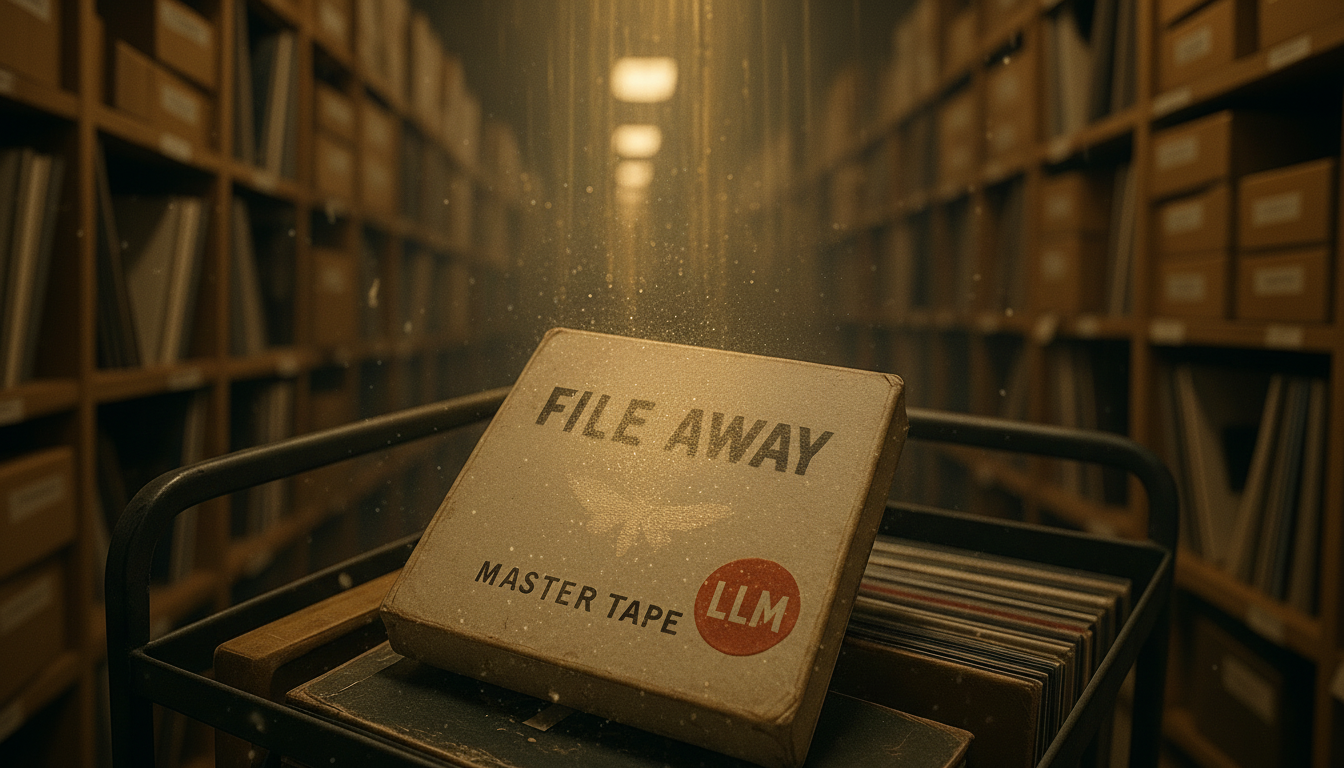
Artists, catalogs and audiences now flow into the same neural system. The label of the future isn’t an office; it’s a model trained on everything.
Before life got busy with family and adult stuff, I spent countless hours building tracks on an MPC2000, Juno-60 and a technics 1200 turntable. Today a model generates the same volume of material in seconds, and the difference is impossible to ignore. The track I generated on Udio last week wasn’t emotionally moving, but it had the strange familiarity of something that could’ve existed, a piece assembled from patterns the model absorbed from music I’ve spent my whole life listening to. The machine wasn’t imitating. It was remembering without the burden of being human.That feeling sits under the industry’s accelerating shift toward AI. The recent wave of partnerships and lawsuit settlements only made a long-running, mostly quiet exploration visible. What looks like legal housekeeping is closer to a reconfiguration of the industry’s foundation, a shift from treating catalogs as assets to treating them as training data. The recent run of settlements and licensing deals between the majors and AI-music companies makes the direction clear. Labels aren’t stepping lightly into this. They’re reorganizing around systems that learn from their catalogs.A record catalog used to be a library. In an AI ecosystem, it becomes memory. Once those recordings enter a system, the model starts to internalize all the small things no one ever wrote down. It learns why certain harmonic choices show up in specific eras. It learns the production fingerprints of different labels and scenes. It learns the peculiar ways creativity clusters around certain accidents. None of this feels technical. It feels like the catalog’s speaking through the model.The majors are building Label Learning Models, and the acronym fits too well to be coincidence.Models don’t just generate music. They eventually learn the logic behind what the industry values, what gets repeated, what gets ignored, what becomes a trend, what gets buried, what lingers inside the collective ear. Once that learning happens, the model stops being a tool and starts being a participant.And that shifts the artist’s position in a way that feels subtle at first. When an artist opts into training programs, their voice and stylistic habits become part of a larger pattern. It’s not theft and it’s not imitation. It’s something more strange. The machine doesn’t sound like them. The machine understands why they sound like themselves, and that understanding becomes reusable.Some artists treat this like a sketch engine. Others see it as insurance. Others treat it like building a synthetic version of themselves that can handle the workday when they can’t. But every path ends in the same place: the artist becomes one of the model’s reference points rather than its primary author. Their identity stays intact, but the idea of authorship starts to drift.Fans shift too. Once an audience can generate convincing variations of the music it loves in seconds, the boundary between listening and creating starts dissolving. The gap that used to define music, intention on one side and reception on the other, gets tighter. The system starts to learn from the patterns of taste itself. Behavior becomes training data. Desire becomes part of the creative loop.This is the ecosystem the majors stepped into when they signed their deals. They’re feeding decades of music into systems that can reorganize it in real time. They’re placing the archive inside a machine that reacts faster than any human meeting or A&R gut check. Once the model is trained on catalog, artists and fans, the label’s no longer the center of the process. The model becomes the gravitational point everything else moves around.What grows inside that center isn’t predictable. It isn’t even fully visible. You can hear the output, but you can’t see the structure. The industry’s teaching the machine its past while trying to control the version of the future that emerges, and it’s not clear that control scales in any meaningful way.I spent years working as an assistant at Capitol Studios in Hollywood, watching what it actually took to make recorded music. Eighty-five piece orchestras brought in for television scores. Tens of thousands of dollars spent before a single note was approved. Union players, engineers, assistants, contractors, entire ecosystems moving in unison. Artists staying in those rooms for weeks, shaping the sound of analog console preamps, vintage microphones, the character of a space you can’t fake. Every hour cost money. Every take carried weight. Hundreds of thousands of dollars that eventually had to be recouped. That pressure shaped the work as much as the art itself.You feel that most clearly when you think about the weeks spent in studios, the late nights in search of a sound no one else could hear yet, the calluses on your fingers from guitar strings, the endless takes that never quite landed. That effort used to act as a filter, a pressure that shaped decisions and gave the work a kind of human weight. When a model can sprint through that entire process in seconds, it isn’t nostalgia you feel. It’s the realization that the friction itself once meant something. And with that filter gone, the question becomes simple and unsettling: what takes its place?The answer isn’t here yet. Artists are adjusting. Labels are repositioning. Fans are generating. Everything’s in motion, and the model’s learning from all of it. Some of this feels bonkers when I step back, and maybe it isn’t that deep. The truth’s still forming, but it feels important to pay attention.