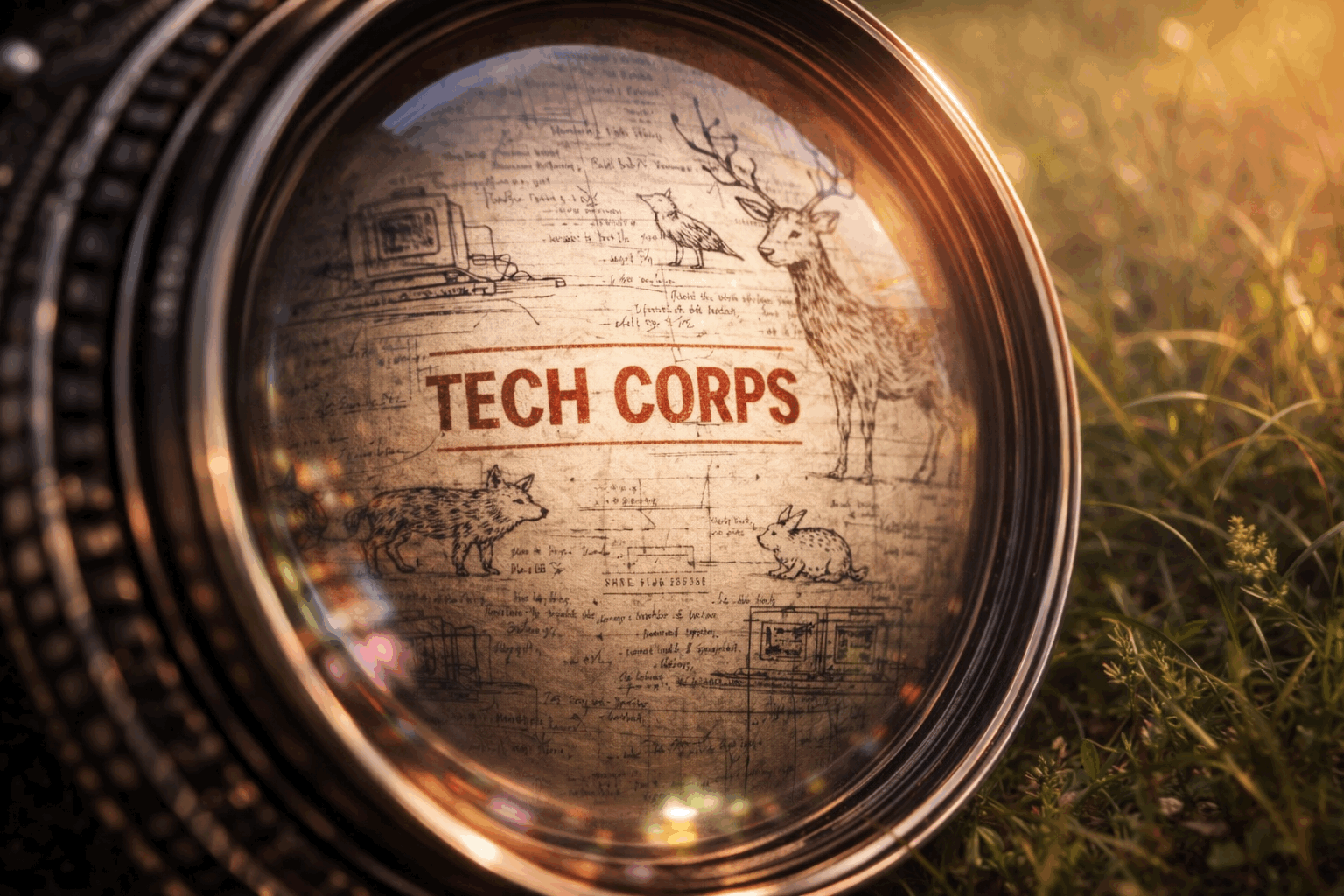
A 1967 dream about machines and humanity just got a government program. The full image is slowly becoming clear.
Richard Brautigan wrote All Watched Over by Machines of Loving Grace in 1967, imagining a world where "mammals and computers live together in mutually programming harmony." Sharing the natural world so completely that the distinction between them had simply dissolved, a world where the machines handled the hard part and humans were free to return to something more natural. Whether he truly believed that was possible is a question the poem itself can't answer.For sixty years the cybernetic meadow has stayed in the background. Soft, unresolved, something happening in server farms outside Phoenix, coworking spaces in Shoreditch and tech campuses in Shenzhen. The foreground was always the hub — Silicon Valley. Then gradually the cluster of cities around it, then the developed world's wired middle class. The meadow was always the blur at the edge of the frame, easy to overlook.Back on February 21, the Peace Corps announced a program called Tech Corps. Someone briefly reached for the focus ring. It's been five weeks now and I've been waiting for the dust to settle a bit but I can't wait any longer. The Language They ChoseThe day before the Peace Corps announcement, White House Office of Science and Technology Policy director Michael Kratsios formally introduced the program at the India AI Impact Summit in New Delhi. The program wasn't born in a humanitarian briefing. It was born at a trade summit, in front of foreign heads of state and business leaders, as part of a suite of AI export initiatives. The Peace Corps framing came the next day.Kratsios described the mission as providing "last-mile support in deploying powerful AI applications." The Peace Corps described it as an initiative that "deploys technologists to support last-mile adoption of American AI." Two descriptions of the same program, both using last-mile. Both revealing the same mental model.In case you're wondering, last-mile is logistics vocabulary originating from freight and telecommunications, the final stretch of a supply chain, the distance between distribution centers and doorsteps. It's how industries talk about getting product to endpoints. When you apply it to communities in rural Kenya or coastal Bangladesh, something shifts in the framing. The people receiving the service are no longer participants making choices, they're the last stop on a delivery route that originated somewhere else entirely, somewhere far up the socioeconomic ladder.This isn't a random choice of words. Someone sat in a room and reached for that phrase naturally, without hesitation, because that's actually how the program's architects are thinking about the people on the receiving end.Tech Corps will recruit STEM graduates and AI professionals and send them to work on agriculture, education, health, and economic development. The volunteers will almost certainly believe wholeheartedly in what they're doing. The agricultural tools will probably improve yields somewhere and the educational software will most likely reach students who need it. None of that is in question.What's worth looking at is the structural prerequisite: volunteers are placed exclusively in countries already enrolled in the American AI Exports Program, a framework created by executive order to expand US positioning in the global AI market against competitors, specifically China. The diplomatic agreement is struck first, then the service follows, and without anyone paying much attention, Brautigan's meadow has an enrollment requirement. As of the program's launch, no country had formally joined. The enrollees are still being recruited.The Focal Plane ShiftsHere's what's actually been happening for the past few decades, underneath the hype cycles, product launches and the discourse about AI changing everything.Technology spreads. It always has. Not because of programs or policy, but because useful tools find people who need them. Farmers in Ghana have smartphones. Teenagers in Manila are doom scrolling TikTok. Market vendors in Nairobi are sending mobile payments. Technology has moved through everyday use, through adaptation, through communities finding the parts that worked and ignoring the parts that didn't. No executive order required. No enrollment in a competitive positioning framework. Just people and tools finding each other the way they always do.That organic spread is real and it's ongoing. It's just not what Tech Corps is.Tech Corps represents the moment when the largest tech economy on the planet decided that the organic spread wasn't moving fast enough, or toward the right platforms. The moment when market share became foreign policy and foreign policy became volunteerism.The cybernetic meadow has been out there the whole time, growing at its own pace in the background powered by our need to measure and optimize. What just happened is that someone decided to accelerate it and make sure that when the full image finally comes into focus, the architecture running underneath it is built on American platforms, and deployed under terms agreed to before anyone hopped on a plane and loaded up a PowerPoint.Who's Holding the MapLet's be honest about what the dual mandate actually describes, using the program's own language.The Kratsios remarks delivered in New Delhi state openly that Tech Corps will benefit host communities and secure US competitive positioning against China. That's not an interpretation. It's the White House on record, in front of foreign heads of state. The program serves two masters simultaneously, the village and the market, and names both without apology.This isn't unprecedented. The original Peace Corps existed inside Cold War geopolitics where volunteers building schools in Latin America also represented a kind of soft power. The difference is that in 1961 the State Department didn't put the geopolitical rationale in the first paragraph. Now it does. Whether that's honesty, confidence or another tactic altogether is worth sitting with for a minute.It's pretty clear that the tech giants and platforms that dominate the American AI industry have an interest in being the architecture that the global south adopts. Not because the executives are villains but because that's how global markets work. If the village runs your AI tools, trains its students on your platforms, and processes its agricultural data through your systems, you have a customer. Most importantly, you have data and a dependency relationship that's very difficult to unwind once it's established.The American AI Exports Program's own website says it plainly: "Export the full stack of American AI." American tech companies form consortia, submit proposals, and receive federal support to sell the complete package to foreign governments, hardware, data systems, models, security, applications, all of it. Tech Corps volunteers show up after the deal is done. And the U.S. Tech Force, stood up two months before Tech Corps, is running the same play domestically, pushing technologists into federal agencies to modernize the government overseeing the whole thing.The consortia portal opens April 1 and the volunteers are already being recruited.The volunteers won't carry that agenda consciously. But they'll carry the architecture in their Slack channels and task boards. The stream in the meadow they're building flows through particular platforms, moving in a direction that was mapped long before any of them touched down on foreign soil.The Meadow Comes Into FocusBrautigan's poem has been blurry by design for sixty years. The uncertainty about whether it was sincere or satirical has given it legs over time. The dream of human-machine harmony could be beautiful or ominous depending on how you held it. The bokeh in the image it conjured was the point. The third stanza is where he gets specific about what the dream actually delivers. A cybernetic ecology where we are "free of our labors and joined back to nature, returned to our mammal brothers and sisters."The Tech Corps announcement sharpens the focus. Not because it reveals something sinister, but because someone finally wrote "last-mile adoption of American AI" in a government document and called it service. The vocabulary makes the frame visible. The volunteers will carry that dream to the last mile. They'll arrive in host communities with tools designed to reduce labor, in agriculture, in education, in healthcare. The dream they're delivering is real. Some of it will work. Some fields will produce more. Some clinics will run better.But Brautigan's freedom from labor had no invoice attached. The cybernetic ecology he imagined didn't require an enrollment agreement or a trade framework or a prior diplomatic relationship with a superpower. It was just the meadow. Open. Mutual. Free.This version comes with a platform dependency that's not easily abandoned. The village that runs its agricultural data through your systems, trains its students on your tools, processes its clinic records through your software, that village is free of certain labors. It is not free of you.The unsettling part isn't that the program might be a cover for something else. The unsettling part is that it probably isn't. The earnestness will likely be genuine. The volunteers will likely believe in what they're doing. And the dream of freedom from labor will likely arrive exactly as advertised. With terms and conditions attached.Whatever Brautigan intended, the meadow he described had no center. No one holding the clipboard. His version had no approved countries list, no executive order, no platform dependency buried in the fine print. Just mammals and machines and something like grace.The meadow is arriving. The focus dial is turning. The full image is almost here.