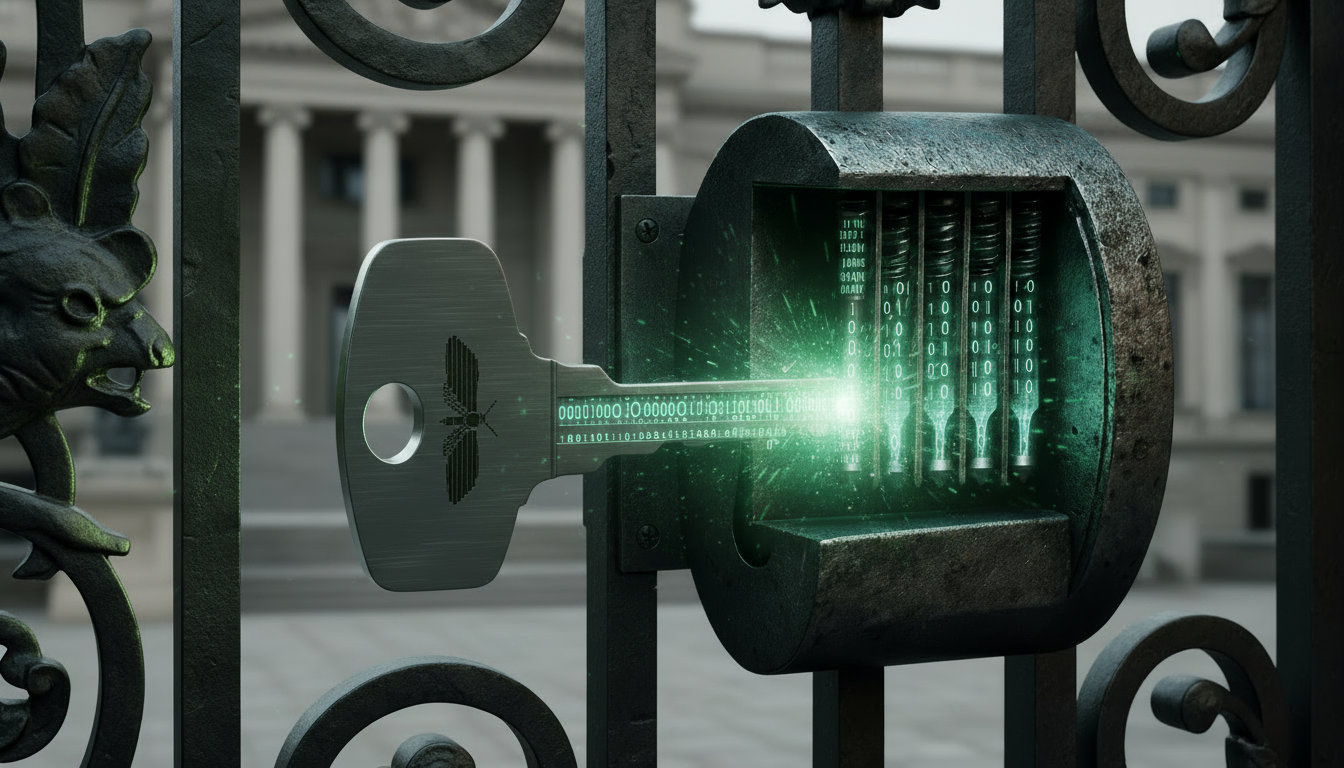
Inside the underground network sharing London’s museum passes and what it reveals about how the world’s innovators are reimagining ownership, access, and belonging from the ground up.
Somewhere in London, a small metal lockbox holds a shared museum pass. The box is discreet and unmarked. It's ordinary, part of a community that trades in trust more than currency. Known informally as the Art Membership Project, the initiative first drew wider attention after The Guardian recently reported on how a single lockbox was opening doors across London’s museums. Participants (primarily artists, teachers, and freelancers) share museum passes through a system of hidden pickup points coordinated by encrypted group chats. No one takes ownership; each card is treated as a shared key. “It’s less about rebellion and more about fairness,” one participant told The Guardian. Hundreds of participants have joined since its launch, all united by a simple principle: if culture is meant to be public, access shouldn’t depend on your bank account.The Cost of BelongingLondon’s major museums still advertise “free entry,” but most of what feels culturally alive like blockbuster shows, previews, and members’ rooms all sit behind a paywall. A Tate Modern membership costs about £120 per year. Add the V&A, the Serpentine, and the National Gallery, and a working artist could spend half a month’s rent just to stay connected.As public funding shrinks, institutions rely on membership schemes for revenue, turning access itself into a kind of currency. That shift has created an invisible divide: those who can afford proximity to art, and those who watch from outside. Cultural economists have long noted the contradiction: museums present themselves as democratic while their membership models quietly reinforce class boundaries. The Art Membership Project simply exploits that gap by redistributing underused passes among people already living and working in the city’s cultural orbit.A Network Built on TrustThe system runs with a mix of analog simplicity and digital coordination. Members communicate through encrypted group chats and move cards through small lockboxes at undisclosed pickup points. New participants join by referral rather than open sign-up. There’s no central leadership, no formal structure, just loose rules that keep the cards circulating. Members track when each card is borrowed, leave exhibition notes for the next visitor, and replace cards when they wear out.One participant described it as “the opposite of a subscription model—nobody profits, but everyone participates.” That ethos, more than the mechanics, has kept the initiative intact despite its visibility. Some cultural workers have expressed sympathy for its aims, acknowledging that many in the arts struggle to afford the very spaces they help sustain.Institutional UneaseEven before The Guardian’s recent coverage, several London museums had begun discreetly reviewing membership ID requirements. According to that report, some institutions had already implemented additional checks and photo verification after becoming aware of shared membership use. Official statements cited “revenue protection,” but insiders admitted that stricter checks would do little to stop shared use because the community is simply too diffuse to monitor.When people build parallel access systems, they’re not attacking institutions, they’re adapting around them. In doing so, they expose how fragile the promise of public exposure to culture has become.Beyond the MuseumThe Art Membership Project isn’t unique. Across cities, similar improvisations are emerging wherever entry is priced beyond reach.Sharing HealthIn the United States, member-owned insurers like Common Ground Healthcare Cooperative and Community Health Options still operate on cooperative principles, while digital collectives such as Opolis are testing blockchain-based models that let independent workers manage benefits together. Further west, the early-stage IndigiDAO project, developed through MIT’s Solve fellowship, is experimenting with blockchain-enabled cooperative governance for Indigenous communities. Its goal is to create self-sovereign digital co-ops that circulate local wealth and decision-making power within tribal nations, blending traditional stewardship with decentralized infrastructure.Together, these fragments hint at what a broader health and wellness co-op could become—a transparent, member-governed alternative where care functions as a shared right.Sharing KnowledgeIn Berlin, DIYbio Berlin hosts open biotechnology sessions where members share lab space, tools, and data rather than depend on private or university systems. The movement reflects a growing push to democratize access to scientific research—treating knowledge as something to be collectively maintained, not individually owned.At a larger scale, the BIO Protocol community extends this logic globally. As part of the decentralized-science (DeSci) movement, it coordinates tokenized funding for open biomedical research, allowing contributors to collectively decide what gets studied and how results are shared. The protocol isn’t about disruption so much as ownership—transforming research itself into a shared, transparent commons.Sharing ToolsIn Oakland, Liberating Ourselves Locally carried the same ethos into physical space. Founded in 2011 by a coalition of Bay Area technologists, artists, and educators, the community-run makerspace operated for a decade as a hub for self-determined learning and repair. Members shared 3D printers, sewing machines, woodworking tools, and soldering stations, and offered free or sliding-scale workshops on coding, electronics, and bike maintenance. Before closing its doors in 2022, it had grown into a model of how open infrastructure can anchor local empowerment—proof that shared infrastructure can be both practical and profound.Sharing SoundIn Australia, The Push has spent nearly four decades creating pathways for young people shut out of traditional music spaces. Now, through its new Give-A-Gig campaign—launched in partnership with AusArt Day and backed by Live Nation Australia—the organization is inviting Australians to fund first-time concert experiences for young people priced out of live music.While The Push operates as a formal nonprofit rather than an underground collective, its approach carries the same spirit of redistribution: transforming exclusion into participation through shared resources. Since its founding, the group has supported more than 250,000 young Australians through concerts, workshops, and mentorship programs—proving that cultural access can still be a collective act.The Limits and Promise...of SharingInformal systems have their contradictions. The London collective depends on a mix of participants and supporters to stay afloat—many of the original passes were purchased through small donations from local art galleries, according to The Guardian’s reporting, rather than individual members. That shared-funding model reinforces the project’s communal ethos but also introduces fragility: as the initiative grows, replenishing or expanding memberships requires continued trust and coordination.Growth also threatens anonymity: what works for a few dozen participants becomes unmanageable at scale. And as institutions adopt stricter verification, logistics grow harder. Yet those constraints don’t erase the point. Projects like the Art Membership Project, Berlin’s open labs, and the DeSci cooperatives all suggest the same quiet shift: when institutions close their doors, people find new ways in.These experiments may be fragile, even temporary, but they’re teaching something institutions forgot—how to share, how to trust, and how to design systems that serve more than those who can afford them. That may be the real legacy of this era’s grassroots infrastructures: not defiance, but adaptation. A reminder that culture, care, and knowledge move best when they move together.